
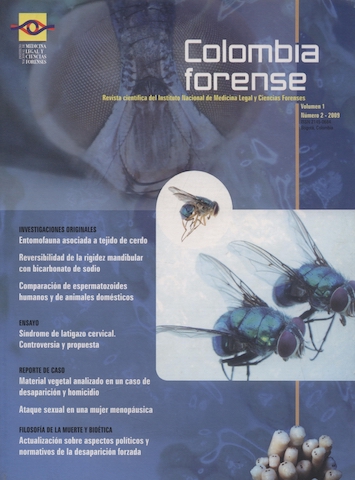
Whiplash syndrome. Controversial aspects review and a forensic proposed
DOI:
https://doi.org/10.60007/antistio.4782Keywords:
whiplash, whiplash syndrome, neck injuries, whiplash-associated disorderAbstract
The incidence in our country about the whiplash is unknown, however, as in other countries, the frequency of this syndrome has been increased and in most traffic accidents in our case, this is presented in sorne type of cervical manifestation with or without clinical signs at the time of medical examination for physical or medical imaging examinations. A review on the state of the art from 2000 to 2007 was developed by selecting 31 items that meet the established selection criteria. Few tapies are so controversial based on very few facts such as whiplash The big difference between the variety of symptoms compared with few clinical signs and the poor performance of the images which support any specific pathology may indicate that symptoms are caused by any accidental neurosis as these symptoms are not the result from physical harm. However, medical experts believe that all patient complaints are not related to any psychogenic disorders. A proposal was submitted for forensic evaluation of these cases by using clinical diagnostic criteria in arder to evaluate them in the forensic field.
Author Biographies
Óscar Armando Sánchez Cardozo, Universidad Nacional
Médico especialista forense Universidad Nacional. Profesor unidad de medicina forense Universidad Nacional.
Jairo León Orrego Cardona, Universidad Nacional de Colombia
Médico especialista forense, Universidad Nacional de Colombia.
Alaín Camacho, Universidad Nacional de Colombia
Médico residente medicina forense, Universidad Nacional de Colombia.
References
ORTEGA PA. Revisión crítica del Síndrome de 18.Trueba OC, Alcázar TD, Villazón JM. Correlación latigazo cervical (1). Cuadernos de Medicina Forense N°34-0ctubre 2003 disponible en: http://scielo.isciii.es/scielo.php?script=sci_arttext&pid=S1135-76062003000400001&lng=es&nrm=iso.
Emerg Med J 2006; 23: 195-201. https://doi.org/10.1136/emj.2005.027102
BMC Musculoskeletal Disorders 2006, 7:103 https://doi.org/10.1186/1471-2474-7-7
Yasuhiro Tominaga, Anthony B Ndu, Marcus P Coe, Arnold J Valenson, Paul C lvancic, Shigeki lto, Wolfgang Rubin and Manohar M Panjabi. Neck ligament strength is decreased following whiplash trauma. BMC Musculoskeletal Disorders 2006, 7:103 https://doi.org/10.1186/1471-2474-7-103
K Atherton, N J Wiles, F E Lecky, S J Hawes, A J Silman, G J Macfarlane and G T Jones. Predictors of persistent neck pain alter whiplash injury. Emerg. Med. J. 2006;23:195-201. https://doi.org/10.1136/emj.2005.027102
Scholten-Peeters GGM, Verhagen AP, Bekkering GE, Van der Windt DA, Barnsley L, Oostendorp RAB, Hendriks EJM. Prognostic factors of whiplash-associated disorders: a systematic review of prospective cohort studies. Pain 2003; 104: 303 - 322. https://doi.org/10.1016/S0304-3959(03)00050-2
Lovell ME, Galasko CSB. Whiplash disorders - a review. Injury, lnt. J. Care lnjured 2002; 33: 97-101. https://doi.org/10.1016/S0020-1383(01)00111-5
Soderlund A, Denison E. Classificaction of patients with whiplash associated disorders (WAD): Reliable and valid subgroups based on the Multidimensional Pain lnventory (MPI-S). European Journal of Pain 2006; 10: 113-119. https://doi.org/10.1016/j.ejpain.2005.01.015
Benoist- M, Rouaud JP. Whiplash: myth or reality? Joint Bone Spine 2002; 69: 358 - 362. https://doi.org/10.1016/S1297-319X(02)00410-4
Sizer PS, Poorbaugh K, Phelps V. Whiplash Associated Disorders: Pathomechanics, Diagnosis, and Management. Pain Practice 2204; 4(3): 249 -266. https://doi.org/10.1111/j.1533-2500.2004.04310.x
Klobas L, Tegerberg A, Axelsson S. Symptoms and signs of temporomandibular desorders in individuals with chronic whiplash-associated disorders. Swed DentJ2004;28:29- 36.
Síndrome del latigazo cervical en www.Ortoinfo.com.
Seigmund GP, Myers BS, Davis MB, Bohnet HF, Winkelstein BA. Mechanical evidence of cervical facet capsule injury during whiplash: a cadaveric study using combined shear, compression, and extension loading. Spine 2001; 26: 2095 - 2101. https://doi.org/10.1097/00007632-200110010-00010
Pearson AM, Ovancic PC, lto S, Panjabi MM. Facet joint kinematics and injury mechanisms during simulated whiplash. Spine 2004; 29: 390 - 397. https://doi.org/10.1097/01.BRS.0000090836.50508.F7
J M. Pearce, Department of Neurology Hull Royal lnfirmary (United Kington) sobre 2352 casos reportados por el Motor Accidents Board in Victoria . J Neurol Neurosurg Psychiatry. 1989 Dec;52(12): 1329- 31. https://doi.org/10.1136/jnnp.52.12.1329
Roig D. Patología cervical (1): Síndromes cervicales sin afección neurológica. Jan 2001; 60:63-64.
Cuadernos de Medicina Forense. Año 2, N°3, Pág.7- 15 en http://www2.csjn.gov.ar/cmf/publicaciones.html
Trueba DC, Alcázar TD, Villazón JM. Correlación clínica vs radiológica en esguinces cervicales secundarios a colisión automovilística. Acta Ortop Mex 2005; 19 (5): 221-224.
Spitzer WO, Skovron ML, Salmi LR, Cassidy JO, Ouranceau J, Suissa S, Zeiss E. Scientific monograph of the Quebec Task Force on Whiplash- Associated Disorders: redefining "whiplash" and its management.Spine 1995;20(8S):1S-73S.
Tenenbaum A, Rivano-Fischer M, Tjell C, Edblom M, Sunnerhagen KS. The Quebec classification and a new Swedish classification for whiplash-associated disorders in relation to lite satisfaction in patients at high risk of chronic functional impairment and disability. J Rehabil Med. 2002; 34:114-118. https://doi.org/10.1080/165019702753714138
Cusick JF, Pintar FA, Yoganandan N. Whiplash syndrome kinematic factors influencing pain patterns. Spine. 2001 ; 26: 1252- 1258. https://doi.org/10.1097/00007632-200106010-00015
Wenngren BI , Pettersson K, Lowenh i el m G,Hildingsson C. Eye motility and auditory brainstem response dysfunction alter whiplash injury. Acta Otolaryngol. 2002; 122:276- 283. https://doi.org/10.1080/000164802753648150
Kivioja J, Sjalin M, Lindgren U. Psychiatric morbidity in patients with chronic whiplash-associated disorder. Spine. 2004; 29: 1235- 1239. https://doi.org/10.1097/00007632-200406010-00013
Revisión crítica sobre el síndrome del latigazo cervical (11): ¿cuánto tiempo tardará en curar? Cuadernos de Medicina Forense N° 34 - Octubre 2003.
Kasch H, Stengaard-Pedersen K, Arendt-Nielsen L, Staehelion Jensen T. Headache, neck pain and neck mobility alter acute whiplash injury. Spine. 2001 ; 21 : 189- 197. https://doi.org/10.1046/j.1468-2982.2001.00179.x
Dall'Alba PT, Sterling MM, Treleaven JM, Edwards SL, Jull GA. Cervical range of motion discriminates between asymptomatic persons and those with whiplash.Spine. 2001;26:2090-2094. https://doi.org/10.1097/00007632-200110010-00009
Ito S, Panjabi MM, Ivancic PC, Peason AM. Spinal canal narrowing during simulated whiplash. Spine. 2004; 29: 1330-1339. https://doi.org/10.1097/01.BRS.0000127186.81814.4A
Ronnen HR, de Korte PJ, Brink PR, van der Bijl HJ, Tonino AJ, Franke CL. Acute whiplash injury: is there a role for MR imaging? a prospective study of 100 patients.Radiology1996;201:93-96. https://doi.org/10.1148/radiology.201.1.8816527
Van Geothem JW, Biltjes IG, van den Hauwe L, Parizel PM, De Schepper AM. Whiplash injuries: is there a role for imaging? Eur J Radiology 996; 22: 30- 37. https://doi.org/10.1016/0720-048X(95)00696-N
Rosenfeld M, Gunnarsson R, Borenstein P. Cassidy D. Early intervention in whiplash-associated disorders. Spine. 2000; 25: 1782- 1787. https://doi.org/10.1097/00007632-200007150-00008
Bronfort G, Evans R, Nelson B, Aker PO, Goldsmith CH, Vernon H. A randomized clinical trial of exercise and spinal manipulation for patients with chronic neckpain.Spine.2001;26: 788-799. https://doi.org/10.1097/00007632-200104010-00020
How to Cite
Downloads
Downloads
Published
Issue
Section
License
Copyright (c) 2024 Antistio: Revista del Instituto Nacional de Medicina Legal y Ciencias Forenses de Colombia

This work is licensed under a Creative Commons Attribution-NonCommercial-ShareAlike 4.0 International License.
| Article metrics | |
|---|---|
| Abstract views | |
| Galley vies | |
| PDF Views | |
| HTML views | |
| Other views | |